
How Taxes and Retirement Security Shape the Decision to Sell Commercial Property
Series post #4
How Taxes and Retirement Security Shape the Decision to Sell Commercial Property
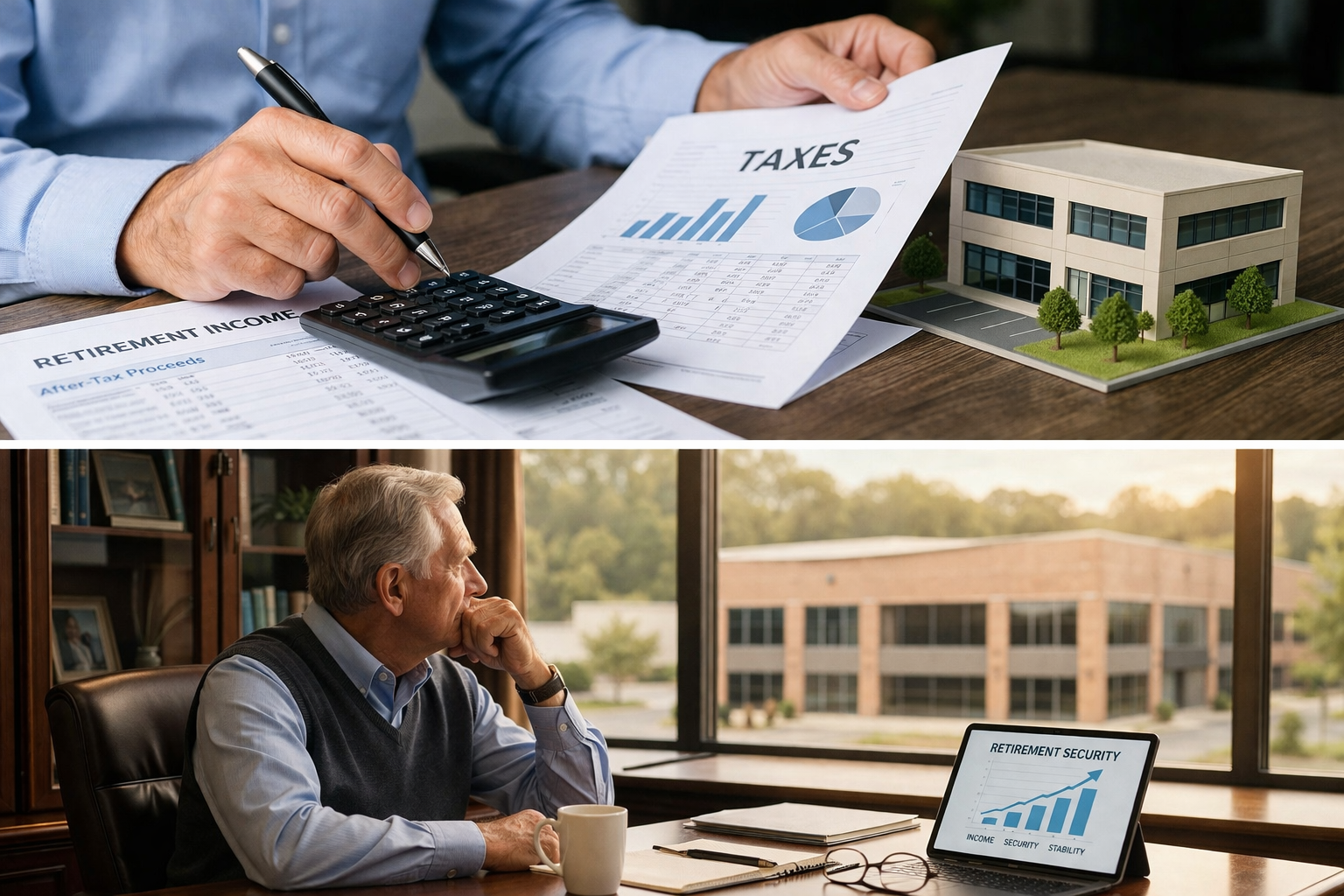
For many long-term commercial property owners, deciding whether to sell in retirement is not simply a real estate decision. It is also a question of financial security:
If I sell this property, will what remains be enough to support me for the rest of my life?
Owners who have held commercial real estate for many years often rely on it — directly or indirectly — for retirement income. As retirement approaches, selling the property means converting a long-held income-producing asset into cash. At that point, taxes become part of a larger concern: whether the proceeds will continue to provide stability and income.
Owners in this stage frequently find themselves asking:
- If I sell, how much will I actually keep after taxes?
- Will the remaining proceeds generate enough income?
- Am I safer keeping the property rather than selling it?
- What if I sell and later need the income I gave up?
- How do I protect what I’ve built if circumstances change?
For many owners, these questions — more than market timing — shape the decision to keep or sell commercial real estate in retirement.
When Selling Raises Income Security Concerns
During active ownership years, commercial property often provides dependable income alongside business or professional earnings. In retirement, that property income may represent a much larger share of financial stability.
Selling can therefore feel less like a transaction and more like replacing an income source. Owners commonly weigh:
- current rental income from the property
- income that sale proceeds might produce
- taxes reducing available capital
- longevity of retirement needs
Many owners hesitate to sell not because the property still fits perfectly, but because they are uncertain whether after-tax proceeds could replace the income and security the property currently provides.
How Taxes Affect Perceived Retirement Sufficiency
Long-held commercial properties often carry substantial unrealized gain. When owners estimate the tax cost of sale, they usually focus not on tax rates themselves but on what remains afterward.
The practical concern becomes: “After taxes, will what’s left still be enough?”
This concern often leads owners to:
- continue holding property longer than planned
- delay retirement transitions
- accept management burden rather than sell
- view sale as financially risky
In this way, tax exposure influences retirement decisions primarily by reducing perceived income-producing capital.
Keeping Property as a Form of Financial Security
For some owners, retaining commercial real estate in retirement feels safer than selling — even if the property requires effort or carries risk. The building may represent:
- familiar income
- tangible value
- inflation protection
- asset control
- legacy wealth
Owners often describe this simply: “I know what this property provides. I’m less certain what I’d have after selling.”
When taxes significantly reduce sale proceeds, this sense of security often strengthens. The property becomes not just an investment but a source of retirement confidence.
When Owners Explore Reinvestment Rather Than Sale
When taxes make outright sale feel unattractive, many owners explore whether proceeds can remain in real estate rather than converting fully to cash. This is where 1031 exchanges often enter retirement planning discussions.
A 1031 exchange allows an owner to sell one investment property and reinvest the proceeds into other real estate while deferring immediate recognition of capital-gain taxes. Owners typically consider this when they want to:
- reduce management intensity
- shift to more stable property types
- simplify ownership
- maintain real estate income
- avoid immediate tax realization
For many retirement-stage owners, the goal is not acquiring new property for growth but transitioning from one property to another without losing capital to taxes.
Selling and Retirement Risk Perception
Owners approaching retirement often view risk differently than during active years. Selling a property introduces uncertainties such as:
- reliability of replacement income
- longevity of retirement horizon
- potential health or care costs later in life
- inflation affecting purchasing power
- market volatility affecting investments
These uncertainties can make selling feel riskier than holding, even when the property itself carries management or tenant risk. Taxes amplify this perception by reducing the capital available to generate future income.
Tax Considerations in Owner-Occupied Business Transitions
For owner-operators, tax concerns often intersect with business exit decisions. Selling a business and building together or separately may affect both net proceeds and retirement income structure.
Owners in this position often consider:
- whether retaining the building provides income after business sale
- how combined sale affects net retirement capital
- whether leasing to a buyer preserves income
- whether taxes reduce proceeds below comfort level
Because both business and real estate may represent decades of accumulated value, tax considerations often shape how owners structure retirement transitions involving both assets.
Balancing Liquidity with Long-Term Security
Retirement-stage property decisions often involve balancing two forms of security:
- liquidity from selling
- income from holding
Taxes influence this balance by reducing the capital available after sale. Owners commonly weigh:
- desire for simplified assets
- need for reliable income
- tolerance for ongoing ownership
- protection against future uncertainty
- family or succession considerations
Some owners sell despite tax cost because simplicity or diversification becomes more important. Others retain property longer because income stability feels more valuable than liquidity.
Earlier Evaluation Expands Options
One consistent pattern among long-term commercial property owners is that earlier evaluation of taxes and retirement income implications often provides more flexibility. Owners who begin considering these factors several years before retirement typically have more choices regarding timing, reinvestment, or transition structure than those who confront them only when preparing to sell.
Understanding how taxes affect retirement security does not replace professional tax or financial advice. Rather, it helps explain why many retirement-stage property decisions unfold the way they do.
Looking Ahead
After considering how taxes and retirement security influence the decision to keep or sell commercial real estate, another important layer remains: how owners successfully transition property in retirement.
That perspective — and the common paths owners take — is the focus of the final article in this series.
This article is intended to provide general information about commercial real estate ownership and retirement-related property considerations. It does not constitute financial, tax, or legal advice. Property owners should consult their financial, tax, and legal advisors regarding their individual retirement planning and investment decisions.
For the final blog post in this series, click here: How Commercial Property Owners Successfully Transition Real Estate in Retirement